Every event has one very specific moment that nobody really talks about.
The moment when an attendee arrives at the entrance, shows a ticket, and waits for permission to enter.
That’s it.
One small interaction standing between a person and the event they paid for, traveled to, planned their day around, or waited months to attend.
And almost nobody notices it when it works properly.
People rarely remember smooth check-ins. They don’t go home talking about how beautifully organized the entrance was. They simply walk through the gate and move on with their evening, conference, festival, concert, or meetup.
In many ways, that is exactly how it should be.
Check-in is not supposed to become the main character of the event.
Built for real-world check-in.
See plans and choose what fits your workflow.
The moment everything becomes visible
When the event check-in stops functioning properly, everything changes very quickly.
Lines begin growing almost instantly. Staff members start improvising solutions under pressure. Communication becomes chaotic. Attendees become frustrated because they usually have no idea what is actually happening behind the scenes.
From their perspective, they are standing ten meters away from the event while something invisible prevents them from entering.
And the uncomfortable part is that many entrances are far more fragile than they initially appear.
A stable internet connection during setup does not guarantee stability once thousands of devices arrive in the same location. Venue infrastructure varies wildly. Temporary event networks behave unpredictably. Hardware combinations become messy. Different staff members bring different workflows. Some entrances work from tablets, some from phones, some from dedicated scanners, and some from whatever device happened to be available that morning.
Meanwhile, attendees keep arriving.
Designing for reality
That reality shaped Hydra from the very beginning.
The goal was never to build event check-in system that looks impressive only during demos or under perfect conditions. The goal was to build something capable of surviving real event environments where pressure, speed, crowds, unreliable infrastructure, and last-minute improvisation are all part of the job.
That is why Hydra was designed around local attendee databases, offline-first operation, fast scanning workflows, and local network synchronization between devices.
Not because those things sound technically impressive, but because entrances need to keep functioning even when conditions around them stop being ideal.
The entrance itself is already stressful enough. The software running it should not become an additional problem.
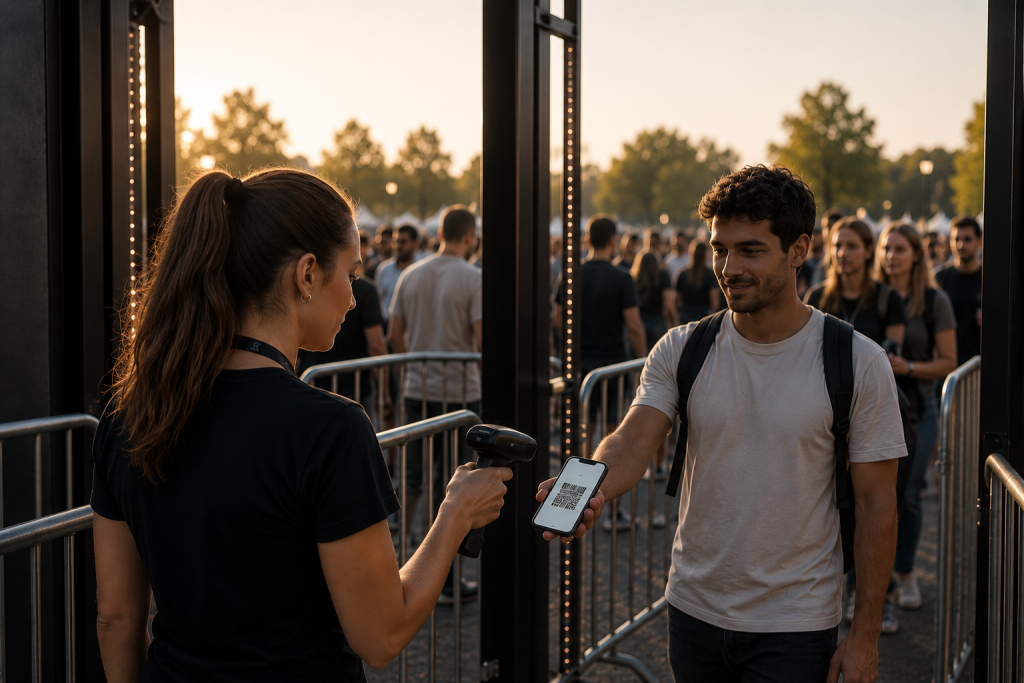
One entrance rarely stays one entrance
A lot of Hydra’s architecture decisions came directly from years of watching how events actually behave in practice.
Sometimes internet disappears completely. Sometimes the venue network survives but becomes painfully slow. Sometimes one entrance suddenly needs three additional operators within minutes. Sometimes organizers realize halfway through setup that several different device types will be used simultaneously.
Those situations are not edge cases.
They are normal event reality.
That is also why Hydra was never designed around a single preferred workflow. Some operators move fastest with dedicated barcode scanners. Others prefer mobile devices. Some events need compact mobile setups. Others work better with large displays visible from a distance.
Different entrances require different approaches, and software should adapt to that reality instead of forcing everybody into one rigid setup.
The first impression of the event
At the end of the day, attendees do not care about infrastructure diagrams, synchronization protocols, or technical explanations.
They care about entering the event quickly and smoothly.
That single moment at the gate may only last a few seconds, but it quietly shapes the first impression of the entire event experience.
Hydra was built around protecting that moment.