A while ago on the website, we explained what Hydra Bridge is.
This time, we want to talk about why it exists at all.
The short version is simple: after years of working with different event ticketing systems, we realized there is almost no standardization anywhere.
Every platform has its own structure, its own terminology, its own logic, and its own way of solving problems. One system stores attendees through WordPress post types, another relies on WooCommerce orders. A third uses custom database tables, while a fourth introduces recurring-event logic that behaves completely differently from everything else.
Then come ticket statuses, seats, check-in rules, customer data, exports, custom fields, permissions, and dozens of other moving parts.
To be fair, most of those systems ended up that way for perfectly understandable reasons.
Some have been evolving for over a decade. Others were built for very specific industries. Some grew feature by feature through years of customer requests. Others expanded far beyond what they were originally designed to do.
None of that is necessarily wrong and we’re not here to judge anyone and anything.
But it creates a problem when you are trying to build a check-in application that should feel stable and predictable regardless of what ticketing system sits underneath it.
At some point, it became obvious that Hydra Check-in app could not realistically learn every platform directly without eventually turning into a giant pile of compatibility logic.
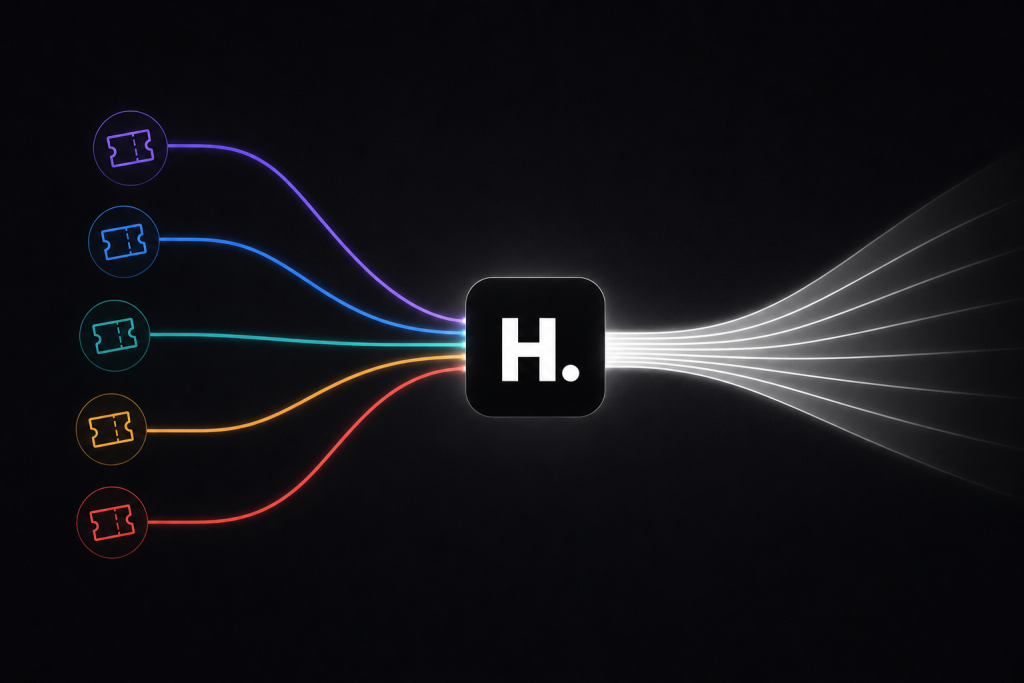
So instead of teaching Hydra Check-in app to speak twenty different languages, we decided to build a translator.
Built for real-world check-in.
See plans and choose what fits your workflow.
Hydra Bridge became our Esperanto for ticketing systems
In many ways, Hydra Bridge is our attempt at creating a common language between completely different event systems.
It sits between the website and Hydra Check-in app, translating wildly different structures into one predictable format that Hydra understands.
That may sound like a small architectural detail, but it changes almost everything about how the ecosystem behaves.
Once attendee data enters the Hydra ecosystem, Hydra Check-in app no longer needs to care where the data originally came from or how the source platform internally organizes it.
Hydra only speaks Hydra.
Hydra Bridge handles the translation.
That separation keeps Hydra Check-in app significantly cleaner and allows it to focus on what it was actually built for: fast and reliable check-in.
The scanner screen should not spend its time trying to understand how a ticketing plugin stores metadata or how recurring events are work internally while people are standing in line waiting to enter a venue.
By the time Hydra Check-in app receives attendee information, Hydra Bridge has already prepared it in a way the application can immediately understand.
Translation gets complicated sometimes
Of course, like with any language, not everything translates perfectly.
Some systems have concepts that do not exist elsewhere. Some workflows behave similarly on the surface but work completely differently underneath. Occasionally we encounter logic that makes us stop and spend a few minutes figuring out what exactly we are even looking at.
That process is part of building Hydra Bridge.
The API contract evolves, new structures appear, existing integrations become smarter and new rules appear when needed.
Sometimes we effectively end up inventing new “words” so Hydra can properly understand workflows.
The interesting part is that every new integration improves the ecosystem as a whole because Hydra Check-in app stays protected from most of that complexity.
The application does not become heavier every time a new ticketing system appears. Hydra Bridge absorbs the differences and keeps the operational side consistent.
Hydra Bridge does far more than connect the app
At first glance, Hydra Bridge can look like a relatively small connector plugin.
Install it, connect Hydra Check-in app, configure a few settings, and move on.
Under the hood, though, a large amount of Hydra’s operational logic actually lives there.
Advanced validation criteria, recurring-event handling, event scoping, compatibility adjustments, feature support, privacy filtering, and data normalization all happen before Hydra Check-in app even receives attendee data.
That architecture keeps the application much more predictable during real-world event usage.
The check-in experience itself becomes faster because the difficult decisions and compatibility work were already handled on the website side ahead of time.
Instead of trying to interpret ticketing systems during live operation, Hydra Check-in app can focus on validating tickets and keeping operators moving.
The privacy model starts before data reaches the device
Privacy was another major reason Hydra Bridge became such an important part of the ecosystem.
Hydra Bridge operates only between your website and your devices. Period.
Attendee data is not routed through Hydra-owned servers, synchronized through third-party infrastructure, or copied somewhere else in the background.
Your website remains the source of truth, while Hydra Bridge controls what information leaves it.
That distinction also changes how privacy works inside Hydra.
If a field is disabled through Hydra Bridge settings or restricted through GATE key configuration, Hydra Check-in app never receives that information in the first place.
It is not hidden after synchronization or visually masked. It simply never leaves the website.
That creates a very different privacy model compared to systems where data is fully transferred to devices and later hidden through interface settings.
Hydra Bridge controls what devices are allowed to possess.
Hydra Check-in app controls how already-approved information appears to operators.
Those responsibilities may sound similar at first, but they solve very different problems.
A quiet plugin carrying a lot of responsibility
Hydra Bridge does not dominate the spotlight.
There are no giant dashboards trying to impress people with charts and enterprise terminology. Most of the time it simply sits quietly in its corner while handling communication between the website and Hydra Check-in app.
At the same time, it is translating ticketing systems, preparing synchronization logic, enforcing privacy boundaries, managing feature compatibility, defining operational behavior, and keeping the entire ecosystem structured and predictable.
For a plugin with “Bridge” in its name, it carries a surprisingly large amount of responsibility.
And that is perfectly fine. Infrastructure rarely looks exciting from the outside when it is doing its job properly.
The Telemetry tab is only the beginning
Some people already noticed the Telemetry tab inside Hydra Bridge.
That section exists as an early glimpse into where the ecosystem is heading next.
Advanced statistics, granular reporting, exportable operational insights, device-level visibility, live event monitoring, and several other systems are already actively being developed around that foundation.
Building those features becomes significantly easier once there is a stable operational layer connecting the website and the devices.
That layer is Hydra Bridge.
From the outside, it may still look like “just a plugin,” but internally it has gradually become the engine holding the entire Hydra ecosystem together.