When the backend disappears but check-ins keep working
So… we tried something stupid.
One of those moments where curiosity quietly overrides common sense and you suddenly find yourself thinking:
“What actually happens if we completely remove the backend from the equation?”
Hydra Check-in was connected to a website running Tickera. The attendee database downloaded normally. Devices were synchronized. Everything looked stable, predictable and honestly a little boring.
Then we completely uninstalled Tickera from the website.
Not temporarily deactivated. Gone. Deleted.
And Hydra just kept checking people in.
We stared at the screen for a second because the whole thing felt slightly absurd. Weird. Yet logical. Expected, even. But still weird on so many levels.
Check-ins continued normally. Devices kept synchronizing locally through Hydra.PULSE network. The pending sync queue quietly collected records in the background while the website effectively stopped existing from Hydra’s perspective.
No dramatic warnings. No frozen screens. No operators suddenly discovering spirituality while staring at a loading spinner and a growing line of attendees outside the venue.
Things simply continued.
Built for real-world check-in.
See plans and choose what fits your workflow.
A little later, Tickera was re-installed again and Hydra synchronized everything back automatically in the background without requiring manual intervention or attention.
Quietly.
Like nothing unusual had happened.
The website stopped existing. The entrance operation did not.
That tiny experiment perfectly captures what offline-first means to us.
Not “sort of usable for a while if wifi becomes unstable.”
Something much more stubborn than that.
Hydra was designed around the idea that entrance operations should continue functioning even when infrastructure has a very bad day. Internet outages happen, servers crash, plugins break, [insert any other disaster scenario]. Hosting provider support occasionally enter states best described as emotionally unavailable.
People at the venue entrance do not care about any of that.
They just want to get inside.
Which is, well… reasonable request.
Hydra.PULSE and the art of not panicking
Hydra.PULSE changes something very important behind the scenes.
In a traditional setup, every check-in device constantly communicates directly with the website. Ten devices means ten separate clients hitting the backend simultaneously. Twenty devices means twenty clients. Add unstable venue internet, last-minute ticket purchases, overloaded hosting and a bit of event-day chaos and things can become extremely entertaining in all the wrong ways.
Hydra can work differently.
One device becomes the master. Other devices become slaves connected through the local Hydra.PULSE network. Instead of every device independently communicating with the website, only the master device talks to it while the remaining devices synchronize locally.
That changes the pressure on the infrastructure entirely.
Instead of the backend trying to maintain communication with a large number of devices during the most stressful part of the event, Hydra effectively creates a local operational layer at the venue itself.
Which means the actual entrance operation becomes surprisingly independent from whatever is happening somewhere deep inside the infrastructure stack.
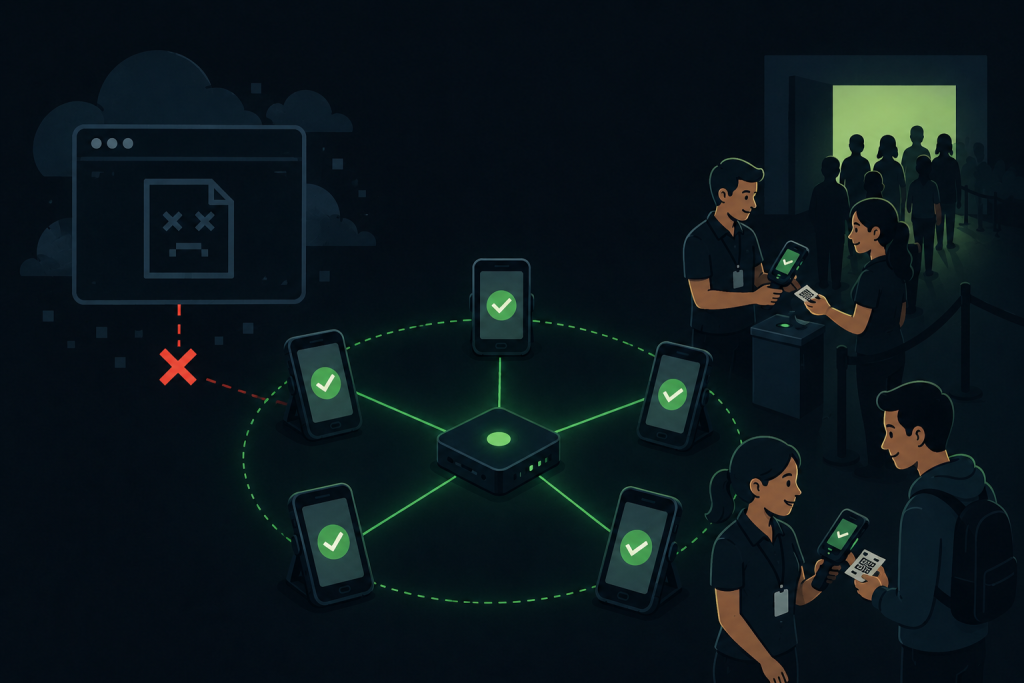
Sometimes the best thing for your server is to leave it alone for a while
Things get even more interesting when infrastructure starts struggling.
Because there is a surprisingly effective strategy available at that point:
Disconnect the master device from the internet for a while.
Seriously.
Let the website breathe. Let traffic calm down. Give everybody involved a chance to investigate whatever sequence of questionable decisions resulted in pushing updates thirty minutes before doors opened.
Meanwhile, check-ins continue locally.
The master device keeps the attendee database. Slave devices continue synchronizing with it through Hydra.PULSE. Pending check-ins wait quietly in the queue until connectivity returns or the backend becomes stable again.
Then the master device reconnects and synchronization catches up automatically in the background.
No panic mode required.
Even the master device remembers
One detail that still feels slightly surreal every time we test it is what happens if the master device itself logs out.
Normally you would expect everything to stop at that point.
Instead, if the attendee database had previously been downloaded, Hydra can restore it locally during login even without internet access and continue operating from there.
Which sounds suspiciously close to magic.
It is not.
No voodoo involved. Or ancient alchemy science.
No mysterious event-tech hidden behind dark interface screens.
Just a slightly unhealthy obsession with reliability.
Reliability should not be a marketing bullet point
Offline-first is one of those phrases that gets thrown around a lot in software marketing. Usually it means “some things continue functioning briefly if the connection becomes unstable.”
We wanted something very different.
We wanted a system where the entrance operation itself becomes resilient. Something that does not immediately collapse because one layer of infrastructure somewhere in the chain decided to stop cooperating.
Because event entrances are stressful enough even when everything works perfectly.
The software should probably not add additional drama to the experience.
Your attendees only care about one thing
People standing outside an event entrance do not care whether WordPress crashed. They do not care if DNS failed, a plugin disappeared, the hosting provider had a catastrophic afternoon or the venue internet collapsed under the weight of six hundred people uploading Instagram stories at exactly the same moment.
They just want to get inside.
And the check-in process should probably respect that.