Sync happens
Sometimes the most important updates are the ones you never planned to work on.
This week was supposed to be spent on new features, integrations, documentation updates, and a handful of smaller improvements that had been patiently waiting their turn. Instead, we found ourselves spending most of the week investigating real-time device synchronization behaviour reported by several customers.
The reports were all slightly different, but they pointed in the same direction. Devices connected directly to the internet were not always reflecting changes as quickly as they should. A ticket checked in on one device could take longer than expected to appear on another. Newly purchased tickets were sometimes not visible immediately. In some cases, refreshing helped. In others, logging out and back in appeared to solve the issue.
The good news was that the underlying data remained correct. Check-ins were not being lost. Records were reaching the website. Ticket limits were still being enforced properly. However, what users saw on their screens did not always match reality quickly enough, and that is a problem regardless of what is happening behind the scenes.
After all, nobody attending an event cares whether the database is technically correct if the device in their hands is showing outdated information.
Built for real-world check-in.
See plans and choose what fits your workflow.
A lesson hidden in a strength
One of the technologies we are particularly proud of in Hydra is Hydra.PULSE, our local network synchronization system.
When multiple devices are operating at the same venue and connected to the same network, Hydra.PULSE allows them to communicate directly with each other. One device acts as the master, while the others synchronize through it. This reduces traffic to the website, improves performance, and allows changes to propagate through the network almost instantly.
It works extremely well and has been one of Hydra’s strongest features from the very beginning.
As it turns out, that strength also taught us an important lesson.
Much of our testing and optimisation over the past months focused on local-network event environments. That made perfect sense because this is how many larger events operate. Multiple check-in stations, one network, one venue, and a constant flow of attendees moving through the gates.
What we underestimated was how many customers prefer a completely different workflow.
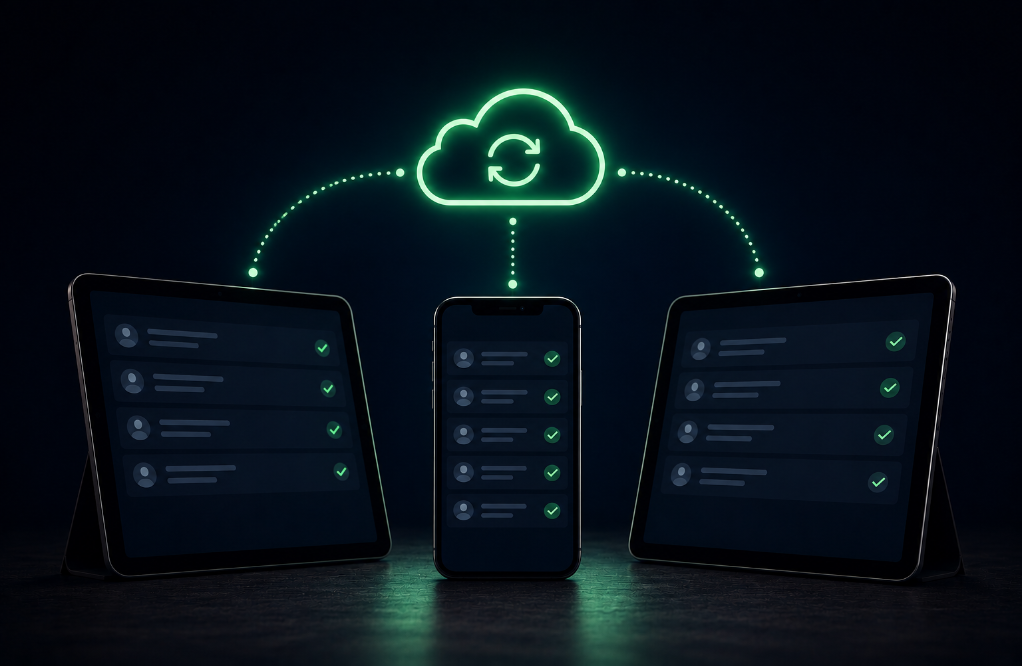
Instead of using Hydra.PULSE, they operate several independent devices, each connected directly to the internet and each communicating with the website on its own. So no master device, no local synchronization, no shared network.
Hydra supported this scenario from day one, but real-world usage showed us that we had not given it the same level of attention we had given to local real-time device synchronization.
That is entirely on us.
So, the issue was that standalone devices were not always learning about changes quickly enough. The information existed but devices simply were not updating their view of the world as aggressively as they should have been.
It is a subtle distinction, but an important one.
Understanding the real problem
One of the reasons this issue took time to diagnose is that the symptoms were easy to describe but much harder to reproduce consistently.
A customer might report that a ticket purchased during an event was not immediately visible on another device. Another customer would mention that a check-in performed on Device A was not instantly reflected on Device B. Someone else would say that pressing refresh did not always appear to help.
At first glance, these reports sounded like different issues.
Once we started recreating customer environments and testing various combinations of devices, however, a pattern emerged.
The synchronization process itself was functioning correctly. Check-ins were being recorded. Updates were reaching the website. The problem was that standalone devices were sometimes relying on information that was slightly older than they should have been, resulting in delays before new changes became visible.
In practical terms, the system was behaving correctly eventually, but “eventually” is not a particularly useful concept when people are standing in line waiting to enter an event.
For check-in software, a few minutes can feel like an eternity.
What changed
Most of this week’s work was spent reproducing customer reports, analysing synchronization behaviour, and testing different approaches to how devices request and process updates.
The latest versions of Hydra Check-in and Hydra Bridge include several improvements aimed specifically at standalone internet-connected devices.
Synchronization requests are now handled more aggressively and more intelligently. Devices are better at recognising when relevant information has changed. Check-in status changes propagate more consistently across independently connected devices.
We also spent time reviewing assumptions that had gradually become part of the system during development. Whenever software evolves over time, it is easy for certain workflows to receive more attention simply because they are used more frequently during testing. This update was an opportunity to rebalance that attention and ensure standalone deployments receive the same level of care as local-network environments.
Just as importantly, we expanded our own testing procedures to better reflect the different ways customers actually use Hydra.
Much more important than just another update
It would be easy to describe this as a real-time device synchronization bug fix and move on.
But in reality, it is a little more significant than that.
One of the advantages of releasing software into the real world is that customers inevitably find workflows you did not anticipate. No matter how much testing happens before launch, people will always discover new ways of using a product.
When that happens, we believe the correct response is not to explain why the software was designed differently. The correct response is to learn from it and improve the product.
And that’s exactly what happened this week.
Hydra is now better suited to venues where devices operate independently. It is better prepared for future integrations. It is better equipped for environments where local networking is unavailable or simply not desired.
Most importantly, it is better aligned with how our customers are actually using it.
Looking ahead
There is a saying in software development that synchronization is easy until you actually have to synchronize something.
Like most jokes in software development, it is funny because it contains more truth than we would like to admit.
The encouraging part is that the issue was identified early, reported quickly by customers, reproduced successfully, and resolved within the same week. The result is a stronger foundation for everything that comes next.
The updates are now live across Hydra Check-in and Hydra Bridge.
If you have already updated, thank you for your patience while we worked through this. If you have not updated yet, now would be a very good time.
And if there is one thing we learned this week, it is that online real-time device synchronization deserves just as much attention when devices are standing alone as when they are standing together.
Last but certainly not least, a big thank you goes to the customers who reported these issues and stayed in active communication with us while we worked on a fix. Your feedback, patience, and willingness to help us reproduce the problem played a huge role in getting this resolved as quickly as we did.
Cheers, guys! It’s an honour to have you as customers.