Why event entrances fail faster than people expect
For the most part event entrance management looks deceptively simple.
Scan the ticket. Validate the attendee. Let people in.
From the attendee perspective, that is usually the entire interaction. The operational side of the process is almost invisible when everything works properly, which is exactly why entrances are often underestimated until real pressure starts building.
After spending considerable number of years around live events, one thing becomes very obvious: entrances behave very differently under real conditions than they do during setup and testing.
A workflow that feels perfectly smooth with ten people standing nearby can become painfully slow once several hundred attendees arrive within a few minutes. A setup that looked organized during rehearsals suddenly becomes chaotic when operators start rotating positions, devices lose battery, internet latency increases, and attendees begin arriving faster than expected.
And the important part is that those situations are not unusual edge cases.
They are normal event conditions.
Small delays become very large problems
One of the biggest misconceptions around check-in is the idea that small delays are harmless.
They rarely stay small for long.
At most entrances, the difference between a one-second validation and an eight-second validation does not sound dramatic on paper. In practice, that difference completely changes crowd movement dynamics once enough people arrive simultaneously.
A single attendee opening the wrong email does not matter much. Five operators waiting for slow validation requests during peak arrival time absolutely does. One scanner battery dying is manageable. Two entrances suddenly sharing one replacement scanner while the queue keeps growing becomes a very different situation.
Built for real-world check-in.
See plans and choose what fits your workflow.
This is exactly why experienced event teams obsess over flow consistency rather than theoretical best-case speed when it comes to event entrance management.
Entrances are not evaluated by how fast they perform once. They are evaluated by how predictably they continue performing after thousands of repeated interactions under pressure.
Real environments refuse to stay predictable
One of the reasons entrances fail faster than people expect is because live environments constantly change while the event is already happening.
Internet connectivity during setup tells you almost nothing about network stability once several thousand mobile devices enter the same area. Outdoor events introduce sunlight, reflections, weather conditions, and visibility problems. Temporary venues often rely on improvised infrastructure. Different staff members naturally develop different scanning habits and workflows.
Even attendee behavior itself becomes part of the equation.
Some people arrive fully prepared with ticket brightness already increased. Others begin searching for confirmation emails only after reaching the front of the line. Some use printed tickets. Others use screenshots, PDFs, wallet apps, cracked phone screens, or email attachments opened through unstable mobile connections.
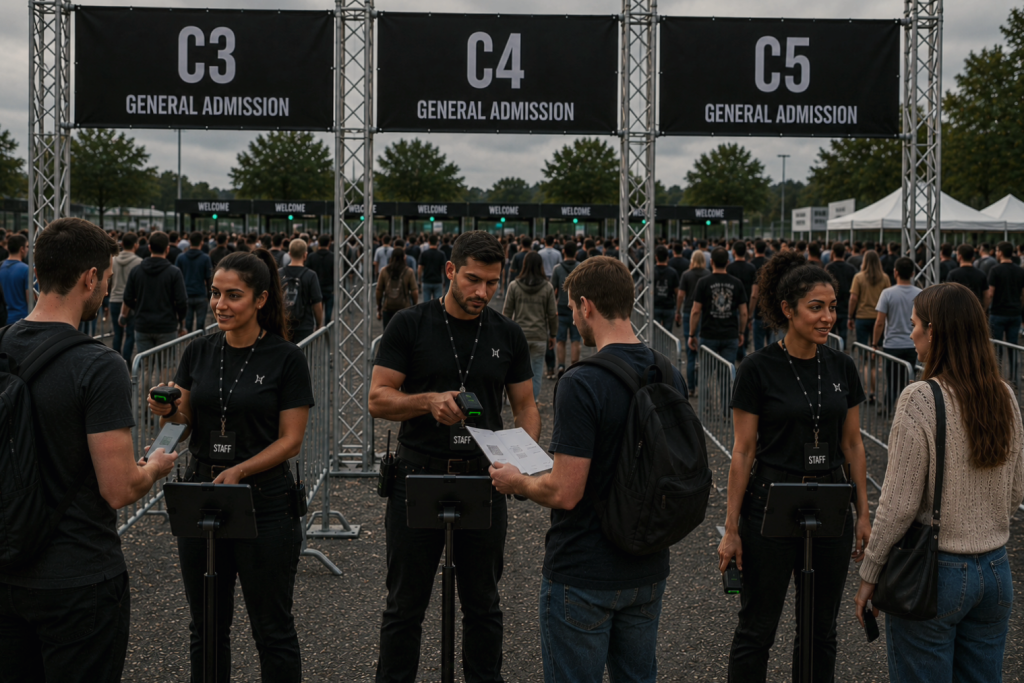
Meanwhile, the entrance itself is expected to keep moving continuously.
Experienced teams also tend to keep backup devices nearby whenever possible.
Not because hardware is unreliable by default, but because live environments leave very little room for single points of failure. Batteries drain faster than expected. Devices overheat under direct sunlight. Someone drops a scanner. A cable suddenly stops cooperating fifteen minutes before peak arrival time.
And sometimes the problem is not technical at all.
One entrance simply becomes overloaded while another operator nearby still has available capacity.
In those situations, having an additional ready-to-go device can make a surprisingly large difference. Two operators scanning simultaneously at the same gate – one from the left side and one from the right – can dramatically reduce pressure during sudden attendee surges without requiring major operational changes.
Experienced organizers usually think in terms of flexibility and recovery speed, not only ideal workflows.
The audience notices immediately
Most technical problems at events remain partially hidden behind the scenes.
Entrance problems do not.
The moment check-in slows down, everybody sees it simultaneously. The line becomes visible and the uncertainty becomes palpable. Staff stress surfaces and attendee frustration becomes notable.
And unlike issues happening backstage or inside production infrastructure, entrance problems directly affect the first real interaction attendees have with the event itself.
That first impression matters more than many organizers initially realize.
A fast and organized event entrance management immediately creates confidence. People relax. Movement feels natural. Staff appears prepared and in control.
A slow or unstable entrance creates the opposite effect almost instantly, regardless of how good the actual event may eventually become once attendees finally enter.
Experience changes how you design systems
One thing years in event environments teaches very effectively is that reliability and predictability usually matter more than flashy feature lists.
That perspective changes how systems get designed.
You stop optimizing purely for ideal conditions and start thinking much more about recovery, fallback workflows, operational flexibility, device diversity, operator behavior, synchronization reliability, and speed consistency during peak load.
Because once the gates open, theoretical workflows stop mattering very quickly.
Only the real-world experience remains.